

Hawaiʻi Regional Economic Stewardship and Advancement Program

The Hawaiʻi Regional Economic Stewardship and Advancement (HIRESA) Program was established in 2024 through an intergovernmental partnership agreement. The program’s purpose is to facilitate statewide coordination and collaboration regarding economic development planning and implementation by and among the public, private, and non-profit sectors. The program is supported by the HIRESA Policy Board.
Initiatives
- Economic Development District (EDD) Designation. In January 2025, OPSD sought and secured designation of the HIRESA EDD from the U.S. Economic Development Administration (EDA). The HIRESA EDD is a defined region comprised of all five counties of the state (Hawaiʻi, Honolulu, Kauaʻi, Maui, and Kalawao). In connection with this designation, OPSD entered into an intergovernmental agreement with the Counties to establish the HIRESA Program to administer the activities that benefit regional economic development. Through the HIRESA Program, OPSD maintains this designation, in order to receive funding to support ongoing coordination regarding economic development planning and implementation.
- Comprehensive Economic Development Strategy (CEDS). The CEDS is a strategy-driven plan for regional economic development. Through county and community level data collection and community input activities, the CEDS provides the foundation by which the public sector, working in conjunction with the economic actors (individuals, firms, industries), creates the environment for regional economic prosperity. The Hawaiʻi Statewide CEDS must be updated every 5 years for entities to qualify for funding under the US Economic Development Administration (EDA) Public Works and Economic Adjustment Assistance programs.
- Hawaiʻi Economic Recovery & Resilience Project. The HIERR Project aims to enable actions toward a more resilient, equitable, and sustainable economy. This planning process is designed to learn from the economic impacts and experiences of hardship associated with the COVID-19 pandemic to inform actions and develop capacity to strengthen Hawaiʻi’s long-term resilience. The HIERR Project will build on both the statewide and county-level goals and objectives for economic development and resilience identified in the Comprehensive Economic Development Strategy (CEDS).
- Opportunity Zones. The Opportunity Zone (OZ) program supports a broad range of residential, commercial, mixed-use, economic development, energy, impact-investment, and other projects in underserved communities. On July 1, 2026, a new designation window will open giving the Governor 90 days to nominate a new set of 25 census tracts as OZs. OPSD is supporting the Office of the Governor during this selection process to ensure that the selected zones promote the housing, energy, transportation, and economic goals of Hawaiʻi.
- OZ 2.0 Overview
- The Office of the Governor and the Department of Business, Economic Development and Tourism, together with the Hawaiʻi Chamber of Commerce, hosted an Opportunity Zones 2.0 Market Activation Summit on June 1, 2026. This event brought together developers, investors, experts, and State and County agencies to explore, learn, connect, and align on the next phase of Opportunity Zones. Click here for access to slides and more information.
- Natural Disaster Economic Recovery Strategy. In 2014, OPSD authored Hawaiʻi’s Natural Disaster Economic Recovery Strategy (NDERS) to strengthen pre-disaster business continuity planning and guide post-disaster recovery actions for both public and private sectors. The strategy particularly focuses on small businesses, which are a major driver of Hawai‘i’s economy. In the decade since, Hawaiʻi has faced unprecedented economic disruptions, including the COVID-19 pandemic, the 2023 wildfires, and Kona Low storms, which underscored the need to update and operationalize the strategy in the face of increasing climate-related disasters. Advancing this work is a key priority for both the Green Fee Advisory Council and the State Legislature, which appropriated $2 million in Green Fee funding for FY27 to support the update and implementation of the NDERS. These funds will support modernization of the strategy and translate it into actionable tools, partnerships, and recovery frameworks that help protect jobs, maintain economic stability, and support residents’ ability to remain in their communities.
Program Structure
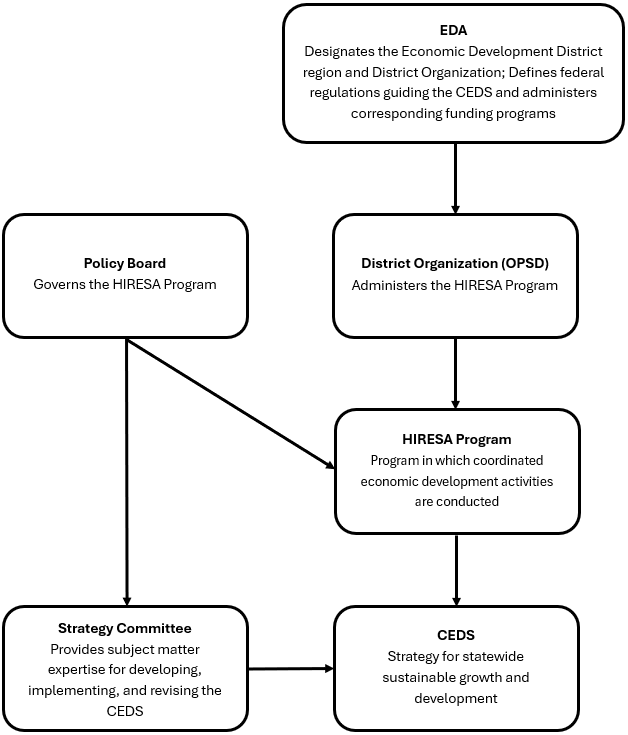
Hawaiʻi’s Economic Development District Designation
Resources on Economic Development Districts
- CEDS Central
- Center for Regional Economic Competitiveness (CREC)
- Economic Development District Community of Practice (EDD CoP)
- National Association of Development Organizations (NADO)
- NADO: Economic Development District Interactive Map
- NADO: AI as a Tool for Economic Development Districts
Find case studies here:
- CEDS Central: Best Practices
- CEDS Central: Resilience
- CREC: Strengthening Regional Economies
- CREC: Turning Thought Leadership into Tools for Action
- EDD CoP: EDDs in Action Case Studies Series
- NADO: Regional Approaches to Resilience Work in the US
- NADO: Economic Resilience & Performance-Based Transportation
- NADO: Meeting the Childcare Challenge
- NADO: EDDs as Regional Housing Changemakers