

State Transit-Oriented Development Program
WHAT’S NEW!
Mass Timber: Its Future for Housing and Public Facility Development in Hawaiʻi
Architect Dean Sakamoto of the Hawaiʻi-based SHADE Institute provided Council members with highlights from a recent Mass Timber Blitz training program held in Honolulu, which brought together architects, engineers, contractors, labor representatives, and public agencies to examine whether the technology is well suited for island conditions.to mass timber construction. The presentation shared insights on prefabricated wood construction systems in which major building components are digitally designed and manufactured off-site before being assembled quickly on location, resulting in safer job sites, reduced material waste, and faster construction timelines. Examples from projects across the continental United States illustrated how mass timber construction can lower carbon emissions while creating warm, natural building environments increasingly used in housing, schools, and institutional facilities.
Representatives from the Department of Hawaiian Homelands (DHHL) described their efforts to explore mass timber construction as well as modular construction and other emerging technologies as part of a broader strategy focused on accelerating housing delivery for Native Hawaiian beneficiaries and building durable homes more efficiently while strengthening long-term community resilience. The DHHL initiative includes exploration of locally available timber resources, which would support forest management, reduce wildfire risks, and potentially establish new local industries tied to forestry, fabrication, and construction. Together, the presentations underscored growing interest in construction approaches that not only address Hawaiʻi’s urgent housing needs but also align with sustainability goals and create lasting economic and environmental benefits for communities statewide.
Presentation slides may be viewed at: https://files.hawaii.gov/dbedt/op/lud/01TODCMTG/20260116/03-TODCouncilslides_MassTimberRev.pdf
The presentation may be viewed starting at 13 minutes 50 seconds into the meeting: https://files.hawaii.gov/dbedt/op/lud/01TODCMTG/20260116/GMT20260116-193259_Recording_gallery_2880x1920.mp4.
1/2026
Infrastructure Coordination Plan Supports TOD Implementation in Iwilei–Kapālama
Lance Wilhelm of The Wilhelm Group presented an overview of the Dynamic Infrastructure Coordination and Execution (DICE) Plan, an initiative developed in partnership with the Hawaiʻi Housing Finance and Development Corporation and Move Oʻahu Forward to better align infrastructure investments with housing development in transit-oriented development areas. The framework connects planned infrastructure improvements—including water, wastewater, drainage, energy, and transportation systems—with specific housing projects to identify investments that can unlock the greatest number of residential units. The Iwilei–Kapālama corridor was highlighted as an initial focus area due to planned rail service and significant redevelopment opportunities.
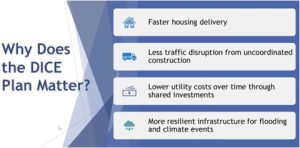 Council discussion emphasized that infrastructure coordination often determines when housing projects can move from planning to implementation. Members noted that regional improvements, particularly drainage and utility upgrades, can support multiple developments at once and reduce delays caused by fragmented infrastructure planning. Discussion also highlighted the importance of coordinated public investment and shared cost approaches to improve project certainty and reduce costs ultimately passed on to residents.
Overall, the DICE framework was recognized as a practical tool to help translate infrastructure planning into implementation by improving coordination among public agencies, utilities, and developers. By linking infrastructure investments directly to housing outcomes, the effort is intended to support funding prioritization, accelerate project readiness, and advance transit-oriented housing development across Hawaiʻi.
Presentation slides may be viewed at: https://files.hawaii.gov/dbedt/op/lud/01TODCMTG/20260116/04-TODCouncil-DICEPlanPresentationJanuary2026.pdf
The presentation may be viewed starting at 1 hour into the meeting:
https://files.hawaii.gov/dbedt/op/lud/01TODCMTG/20260116/GMT20260116-193259_Recording_gallery_2880x1920.mp4
1/2026
Hawaiʻi Interagency Council for Transit-Oriented Development (TOD Council)
On June 29, 2016, Governor David Ige signed into law Act 130, SLH 2016 (SB 3077) which designates the Office of Planning and Sustainable Development (OPSD) as the lead State agency to coordinate and advance smart growth and TOD planning in the State. Act 130 also established the Hawaiʻi Interagency Council for Transit-Oriented Development (TOD Council).
The purpose of the TOD Council is to coordinate and facilitate State agency TOD planning, and to facilitate consultation and collaboration between the State and the counties on smart growth and TOD initiatives. Links to Act 130, SLH 2016 and a summary of its provisions are available below.
With representation from State and county governments and the community, the TOD Council serves as the State’s forum for TOD planning and policy development. The Council is co-chaired by the directors of the Office of Planning and Sustainable Development and the Hawaiʻi Housing and Finance Development Corporation (HHFDC). The TOD Council’s primary responsibilities are to:
- Develop and implement a State strategic plan for TOD, including mixed-use and affordable and rental housing projects;
- Facilitate funding for TOD programs and projects;
- Monitor TOD implementation and recommend needed policy and statutory changes; and
- Review Capital Improvement Project requests for TOD on State lands.
For information regarding TOD Council meetings, please click here or on the link in the sidebar to the right.
Click here to view Act 130, SLH 2016
Click here to view a summary of Act 130, SLH 2016
Other TOD-Related Legislation Enacted in 2016
Act 131 (HB 2293)
Allows HHFDC to develop mixed-use developments in partnership with State and county departments and agencies.
Click here to view Act 131, SLH 2016
Act 132 (HB 2305)
Authorizes the creation of Regional State Infrastructure Improvement Subaccounts within the Dwelling Unit Revolving Fund and the use of the Dwelling Unit Revolving Fund to provide loans and grants to finance regional state infrastructure improvements in areas of planned growth. Also allows repayment from assessments or fees which capture property value increases (IDs or TIF).
Click here to view Act 132, SLH 2016
Act 127 (SB 2561)
Establishes a goal of developing or vesting the development of at least 22,500 affordable rental housing units statewide ready for occupancy between January 1, 2017 and December 31, 2026. Also establishes a temporary special action team on rental housing to make recommendations to the Governor, Legislature, and other parties to achieve the goal.
Click here to view Act 127, SLH 2016
Background
The State of Hawaiʻi is the largest landowner along Honolulu’s 20-mile rail transit corridor, owning about 2,000 acres of land within a half-mile radius of the 21 stations. As construction of the Honolulu rail transit system progresses, the State has a unique opportunity to enhance Oahu’s urban environment by applying smart growth and transit-oriented development (TOD) principles to revitalize neighborhoods, increase affordable housing, and improve accessibility to public facilities and services. On the Neighbor Islands, similar smart growth and TOD principles can be applied effectively in the provision of State facilities and services to encourage quality growth and vibrant mixed-use neighborhoods in urban or rural centers.
In 2012, OPSD and Smart Growth America convened a Project Stakeholders Group to develop a TOD implementation strategy for State agencies, entitled “Leveraging State Agency Involvement in Transit-Oriented Development to Strengthen Hawaii’s Economy.” This effort included three workshops and involved over 40 government and private and non-profit organizations.
In 2015, the State Transit-Oriented Development Task Force was formed, chaired by Senator Suzanne Chun Oakland. Monthly meetings were held to coordinate State agency projects and plans in the TOD areas surrounding the rail transit stations in Honolulu. A status report to the Governor and Legislature was prepared in December 2015.
Contact
If you have any questions about the State’s TOD efforts, please contact staff at OPSD – Land Use Division by email at [email protected] or by phone at (808) 587-2805.
TOD

Stay updated on the City and County's current activities and planning efforts for TOD around each rail station. Click here for more information.